
I used to write checks for plumbing damage. Now I write about it so you do not need the check. If you are researching aav plumbing because you found a small plastic valve under a sink, you have probably found an air admittance valve, or AAV. It allows air into a drain system when water flows out, helping prevent slow drains and sewer-gas odors without running a vent pipe through the roof.
That little valve is useful, but it is not magic. An AAV has moving parts, a limited service life, and installation requirements. When it sticks open or fails to admit air, the symptoms often look like an ordinary drain problem. The difference is that ignoring the warning can lead to recurring backups, cabinet damage, or unpleasant gas odors. A ten-minute check today saves a ten-thousand-dollar call tomorrow.
What an air admittance valve actually does
Every drain needs a way to balance air pressure. When a toilet flushes or a sink drains, water moving through the pipe can create negative pressure behind it. Without proper venting, that pressure can pull water out of the trap beneath a fixture. The trap is the curved section that holds water and blocks sewer gases from entering the home.
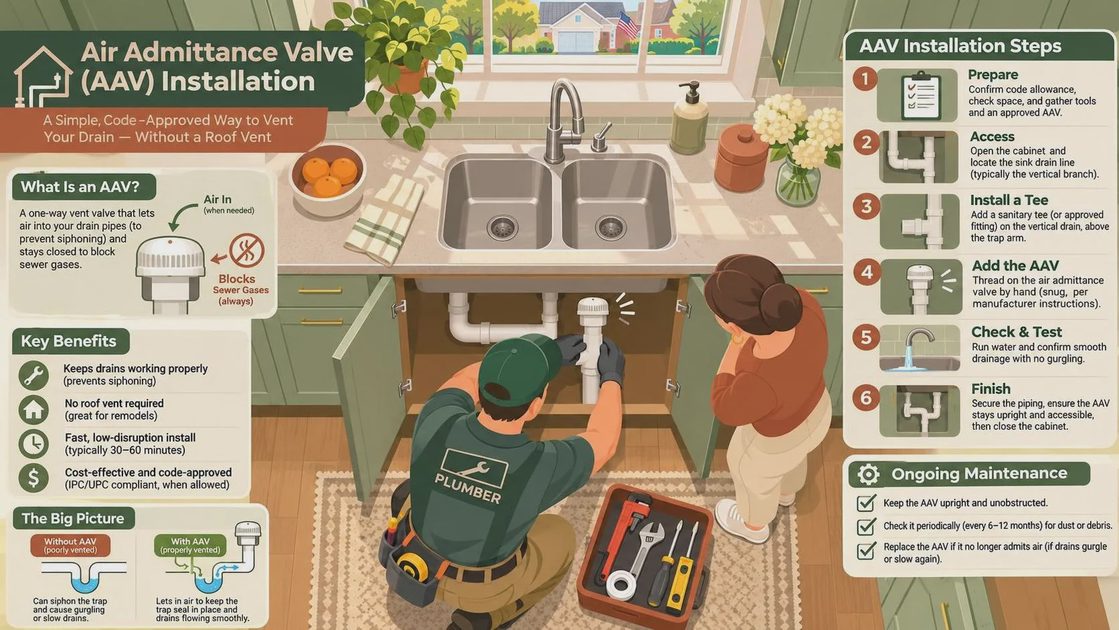
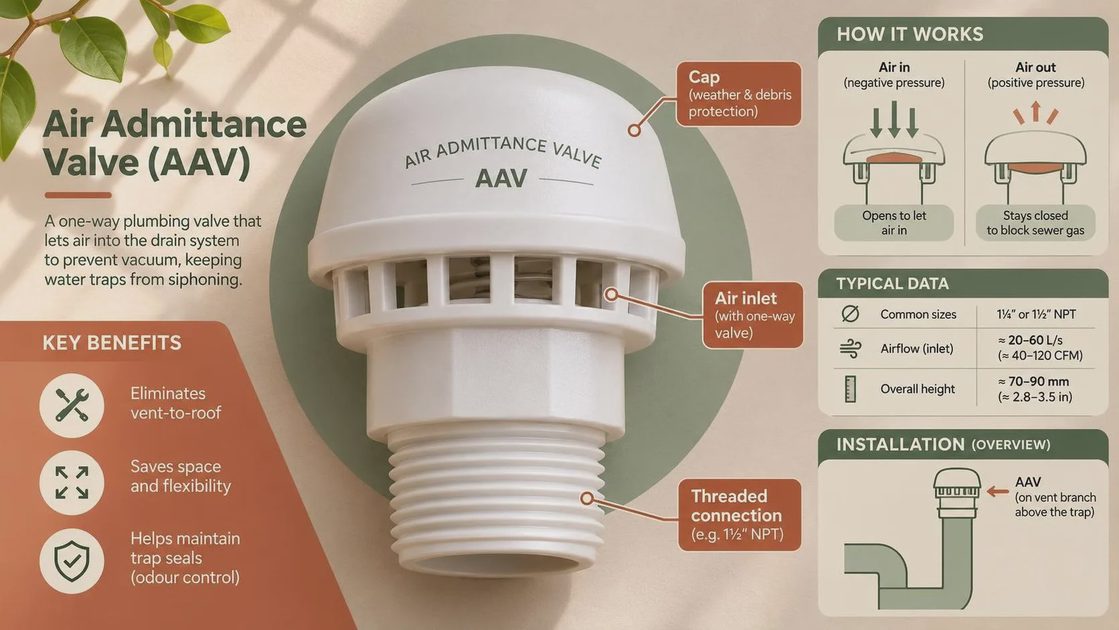
Traditional plumbing vents travel through the roof. An AAV provides an alternative at selected fixtures. Inside the valve is a spring-loaded or gravity-operated seal. When draining water creates negative pressure, the seal opens and lets room air into the pipe. When the pressure equalizes, it closes again.
In practical terms, aav plumbing can help a kitchen island sink, basement wet bar, bathroom vanity, or other fixture where a conventional vent is difficult to route. It does not pump water, clear a clog, or replace every part of a properly designed vent system. It is an air valve, not a drain-cleaning device.
Where homeowners usually find AAV problems
Look under sinks first. The valve is commonly installed above the drain trap and may resemble a short, threaded plastic cylinder with a cap. In a basement, you might find one inside a cabinet, behind an access panel, or near a utility sink. A valve hidden inside a sealed wall is a concern because it needs access for inspection and replacement.
The first warning sign is often a gurgle after the basin drains. You may also notice that the sink empties slowly even after the trap and drain opening appear clear. Sewer odor around the cabinet is more significant. A healthy trap should block that odor, so a smell can indicate a failed valve, a dry trap, a loose connection, or a broader venting issue.
Do not confuse occasional odor from a rarely used basement sink with proof that the AAV has failed. A dry trap is common and inexpensive to address. Persistent odor after the trap contains water deserves a plumbing evaluation.
The inspection thresholds I use
Start with a visual check, not a wrench. Look for white mineral deposits, corrosion on nearby fittings, water staining on the cabinet floor, or a valve leaning under stress from the drain pipe. AAV plumbing should be installed upright and remain accessible. If it is buried behind drywall or packed tightly beneath stored supplies, future service becomes harder and more expensive.
Run a normal amount of water and listen as the fixture drains. One brief gulp is not automatically a failure, especially in an older house. Repeated gurgling, a drain that pauses and then surges, or odor that returns within a day is enough reason to schedule a licensed plumber.
The urgency depends on the evidence. A dry cabinet and one occasional noise can wait for a planned inspection. Active dripping, sewage odor throughout the room, or water backing up into a sink moves the call into the same week. If wastewater is reaching flooring or cabinetry, stop using that fixture until it is assessed.
I used to think every unusual drain sound meant a major sewer problem. Field inspections corrected that assumption. Often the repair is a $100 to $250 valve replacement or a minor connection adjustment, not a $10,000 excavation. The expensive cases usually involve months of ignored leakage or damage hidden inside a wall.
How much AAV repair or replacement can cost
For a straightforward accessible valve, a plumber may charge roughly $150 to $350 for diagnosis and replacement, depending on local labor rates and access. The valve itself is generally a modest part of the bill. If the installation is incorrect, the plumber may need to support the drain, adjust the fitting, or add an access panel. That can push the project toward $400 to $900.
A more serious situation involves an AAV installed where local rules or the plumbing design require a conventional vent. Converting the arrangement could involve opening cabinets, ceilings, or walls. Small interior access work may cost several hundred dollars; extensive rerouting can reach $1,500 to $4,000 before cosmetic repairs.
Water damage is where the ledger changes. A slow leak beneath a sink can swell particleboard, damage flooring, and create conditions for microbial growth. Replacing a cabinet box and a section of flooring can easily exceed $2,000. If water reaches a finished basement ceiling, the total climbs quickly. Insurance coverage depends on the policy and the cause, and gradual maintenance-related damage is often treated differently from sudden accidental discharge.
What not to assume about AAV plumbing
An AAV does not automatically mean the house has unsafe plumbing. These valves are used in legitimate installations when approved for the application and installed correctly. Nor does a newer-looking valve guarantee good performance. A valve can fail internally while its exterior still looks clean.
Do not seal the valve inside a wall or permanently cover it with insulation. It needs air access and service access. Do not rely on drain chemicals to solve gurgling or odor; those products address blockages, not a failed venting component, and can create a hazard for whoever later opens the drain.
Brand names matter less than the correct size, location, orientation, and approval for the installation. A plumber should evaluate the entire fixture drain rather than swapping parts based only on appearance. If multiple fixtures gurgle at once, the problem may be a blocked main vent or drain restriction rather than one AAV.
A simple homeowner decision plan
Take a photo of the valve and the surrounding connections. Note whether the odor appears only after the sink runs, whether the drain backs up, and whether the cabinet floor is dry. That information saves a plumber a second visit and helps distinguish a venting symptom from a supply-line leak.
Next, check access. If you cannot see the valve without removing a wall panel, mention that when booking service. Ask for diagnosis, replacement, and any access work to be separated on the estimate. A clear estimate should identify the valve, labor, fittings, and cosmetic restoration rather than combining everything into one vague number.
For a home purchase, add AAV plumbing to the inspection questions. Ask whether each valve is accessible, upright, free of staining, and appropriate for the fixture. A home inspector can identify visible concerns, but a licensed plumber is the right professional for code compliance and functional diagnosis.
The goal is not to replace every valve on a schedule. It is to catch the one that is noisy, inaccessible, leaking, or repeatedly associated with odor. That is the difference between sensible maintenance and spending $5,000 to prevent a $200 problem.
The ten-minute check to do today
Open the cabinet beneath every sink and look for an AAV, dampness, mineral crust, or a sewer smell. Run the fixture, listen for repeated gurgling, and check the floor again five minutes later. If you find active water, persistent odor, or a drain that backs up, arrange a professional inspection before the symptom becomes background noise.
AAV plumbing is usually a small part of a much larger drainage system, but small parts can produce useful warnings. Catch the warning while the repair is a valve and a service call, not after it becomes flooring, cabinets, and a claim file. Now go walk your basement and open the sink cabinets. You have ten minutes.


No comments yet.