A window doesn't fail all at once — it fails on a clock, and that clock is already running whether you've noticed it or not. Stage one costs $40 in sealant. Stage three, for the exact same window, is a $700–$1,200 frame replacement. The gap between those two numbers isn't bad luck. It's one winter of doing nothing.
So we pulled the exact diagnostic checklist licensed inspectors use, laid out two real repair timelines with the numbers attached, and tracked down the rebate and credit programs most homeowners assume they won't qualify for. Most do. Here's how to tell.
The 30-Second Test That Tells You If a Window Has Already Failed
Before the checklist, try this. Hold a dollar bill in the closed window, halfway up the frame. Shut it and pull. If the bill slides out with no resistance, the seal is already gone, whether or not you can see or feel a draft yet.
That's not a maybe. Insurance adjusters and window techs use this exact test because eyes and hands miss what a compromised seal lets through.
If the bill test fails, or if any of the following look familiar, the window is past the "keep an eye on it" stage.
7 Warning Signs a Window Has Moved From "Fine" to "Failing"
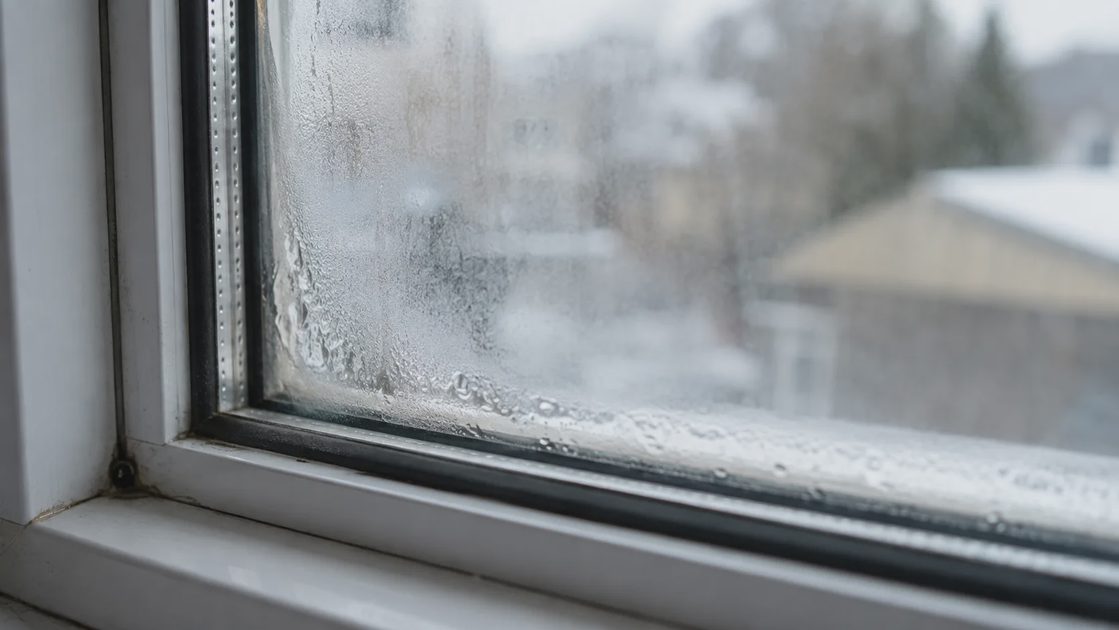
Fog or haze between double panes
The seal holding the argon gas (or plain dry air) between panes has broken. This isn't a cleaning problem — it's permanent, and it means the insulating layer is gone.
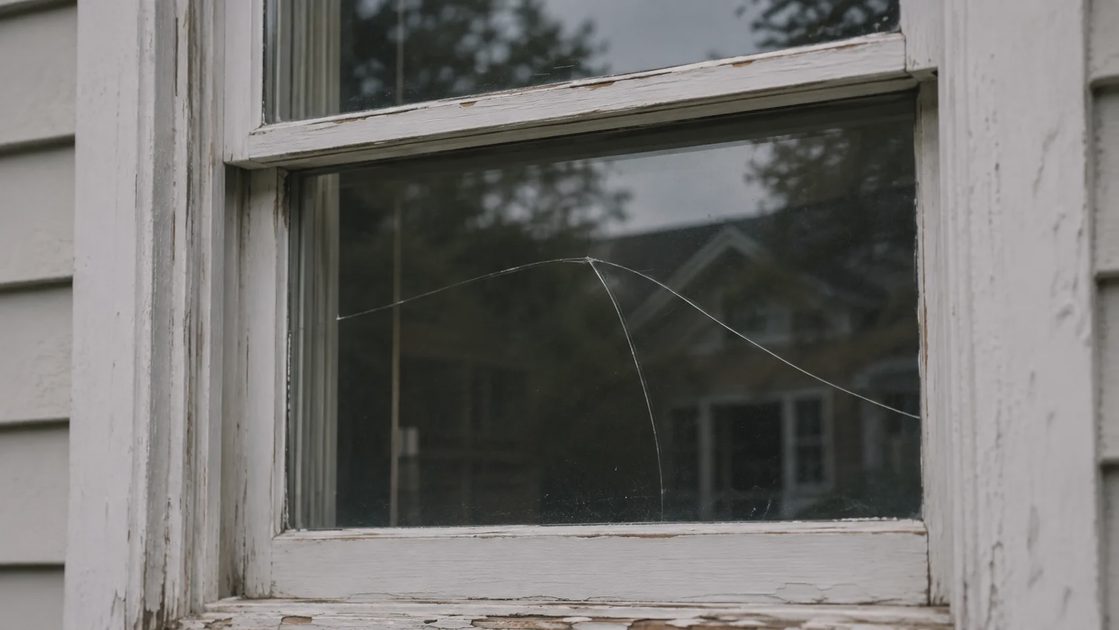
A crack that "walks" — even a hairline one
Glass under seasonal expansion and contraction doesn't hold still. A 1-inch hairline crack in October is commonly a 4–6 inch crack by February, especially in climates with a hard freeze.
Visible daylight around the frame, not the glass
This points to the frame itself pulling away from the house — often wood rot or a warped sash — which is a repair job, not a $12 tube of caulk job.
It won't latch, or takes both hands to open
Frame swelling or a dropped sash usually means moisture has already gotten into the wood or the balance mechanism has failed.
A heating bill that jumped without a rate change
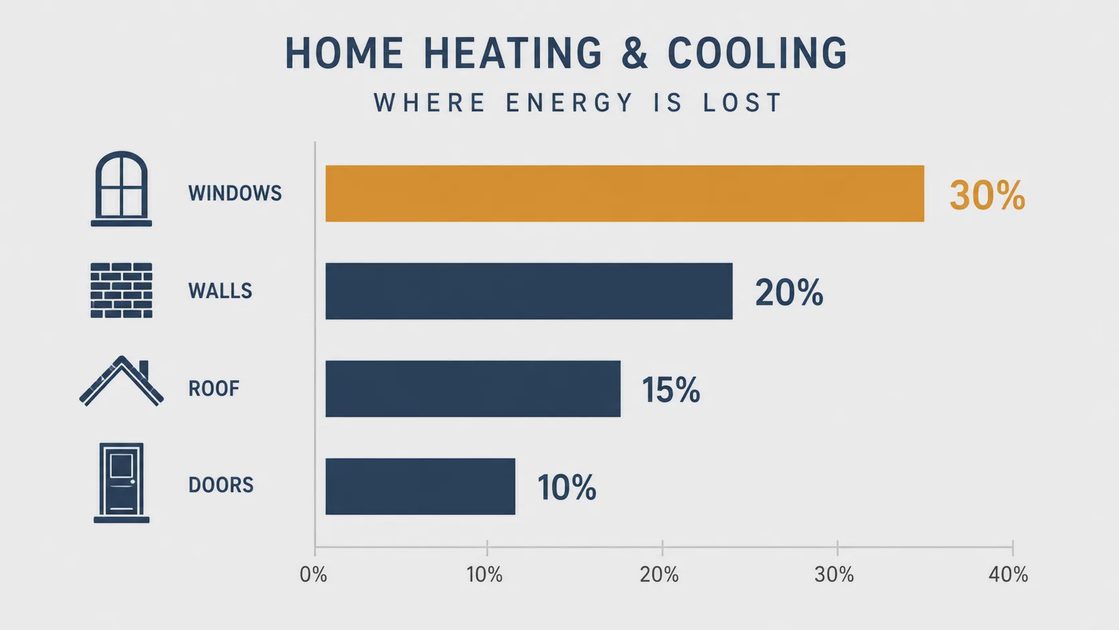
The U.S. Department of Energy estimates windows are responsible for roughly 25–30% of a home's heating and cooling energy loss when seals or frames are compromised — an unusually specific line item hiding inside a normal-looking bill.
Soft, spongy, or discolored wood at the sill
Press a key or screwdriver into the sill. If it sinks in, moisture has been sitting there for months, and it spreads to the wall cavity if it isn't addressed.
Condensation on the inside of the glass in cold weather
Occasional light condensation is normal. Heavy, recurring condensation on interior glass usually means the seal is compromised and humidity is finding the coldest surface in the room — your window.
The $600 Repair That Nearly Became a $9,200 Replacement
Denise R., a homeowner in Columbus, OH, noticed a draft near her kitchen window in late October. It wasn't dramatic — just a cold spot near the sink she chalked up to "old house drafts."
She didn't run the dollar-bill test until a contractor happened to do it during an unrelated gutter visit in January. By then, moisture had been sitting in the lower frame for roughly ten weeks.
Timeline | What was happening | Cost if addressed then |
|---|---|---|
Late Oct | Draft first noticed, seal likely already compromised | ~$40 (sealant + weatherstrip) |
Mid Dec | Frame swelling begins, sash sticking | ~$220 (frame repair) |
Late Jan | Contractor finds soft sill wood, mold beginning | ~$610 (sill + partial frame replace) |
Mar (if left) | Estimated: wall cavity moisture, full unit replacement | $9,200 (full replacement + drywall + remediation) |
Denise caught it at the $610 stage — expensive, but a fraction of where it was headed. The window tech who found it told her plainly: "Every one of these calls I get in March started as a call somebody could've made in October for a tenth of the price."
What Waiting Actually Costs, Month by Month
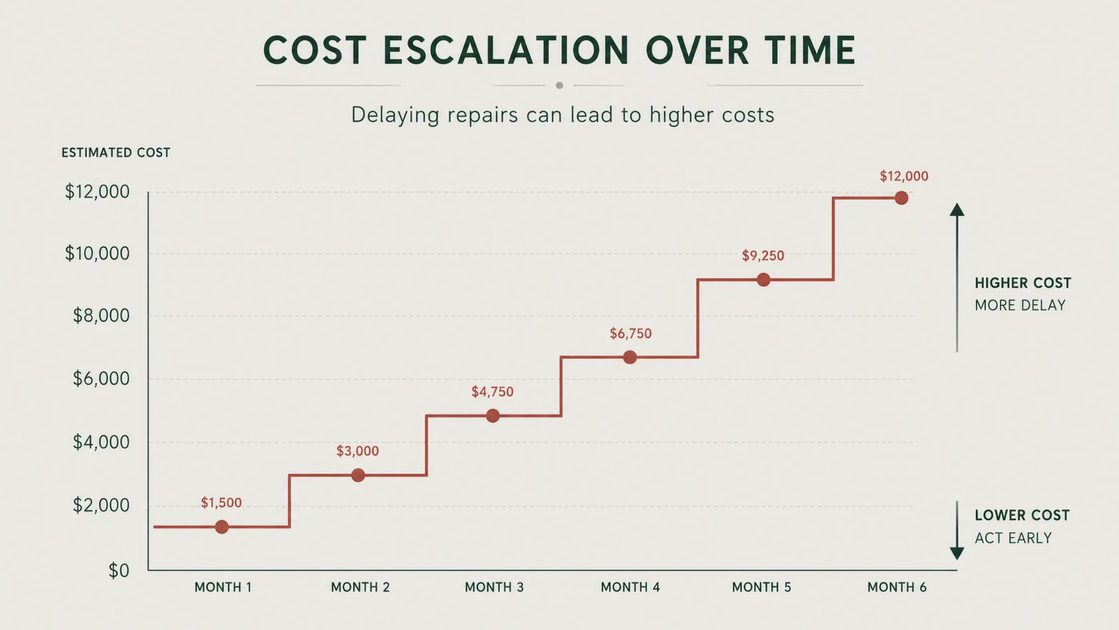
This is the part homeowners tend to underestimate — not the eventual repair bill, but the compounding cost of the months in between. A compromised window doesn't sit still at "slightly worse." It accelerates, because moisture intrusion and thermal loss both feed on themselves: wet wood insulates worse, which increases condensation, which wets more wood.
Stage | Typical cost range | Window to act |
|---|---|---|
Reseal / caulk only | $35 – $120 | 0–4 weeks after first sign |
Weatherstrip + hardware fix | $150 – $350 | 1–3 months |
Sash or partial frame repair | $400 – $900 | 3–6 months |
Full frame or unit replacement | $700 – $1,600 per window | 6+ months / structural involvement |
Replacement + wall/mold remediation | $3,000 – $9,500+ | Left untreated through a season |
None of this requires an unusual house or bad luck. It's closer to the default outcome any time one of the seven warning signs above gets filed under "I'll deal with it eventually." The pattern shows up across climates, ages of home, and window types — the variable that actually changes the outcome isn't the house, it's the number of weeks between noticing the sign and making a call. Contractors who specialize in emergency repair calls often describe the same arc: a homeowner mentions they'd noticed something "a while back," and the estimate reflects every one of those weeks.
The good news, and the part most of this article is actually about, is that the earlier stages are not only cheaper — they're also the stages that current rebate and credit programs are built to cover. Programs like the ones below are typically structured around efficiency upgrades and qualifying replacements, which means the financial support is strongest exactly when you still have options, and weakest once a window has degraded into an emergency, structural repair.
The 2026 Window Rebate Stack Most Homeowners Miss
This is the piece that rarely makes it into a standard "how to fix your window" article, mostly because it changes by ZIP code, income bracket, and utility provider — which is exactly why most homeowners assume it doesn't apply to them and never check. Three separate programs currently stack for a lot of U.S. households:
FEDERAL
Covers up to 30% of the cost of qualifying ENERGY STAR-rated windows, capped at $600 per year for windows/skylights. Claimed on your federal return — confirm current caps and eligibility on IRS.gov or with a tax professional, since thresholds are adjusted periodically.
STATE / UTILITY
Many state energy offices and utility companies run separate rebate programs for insulation, sealing, and window upgrades — often stackable with the federal credit, and sometimes covering repair, not just full replacement.
INCOME-BASED
A federal-to-state program that can cover window and frame repair at no cost for income-qualifying households — one of the most under-claimed programs in home maintenance, according to state energy offices that report consistent year-over-year underspend of allocated funds.
How the Alvarez Family Cut a $6,400 Replacement Down to $3,780
Two cracked double-hung windows and one persistently drafty picture window in a 1990s build in Toledo, OH added up to an initial contractor quote of $6,400 for full replacement. Rather than accept the first number, the Alvarez family compared three local licensed quotes through a free matching tool, then checked what they qualified for.
Line item | Amount |
|---|---|
Initial single-contractor quote | $6,400 |
Lower quote found via 3-quote comparison | −$740 |
Federal 25C credit applied (2 qualifying windows) | −$1,200 |
Local utility efficiency rebate | −$680 |
Final out-of-pocket cost | $3,780 |
The comparison step mattered almost as much as the rebates. Getting multiple quotes surfaced a $740 gap on labor pricing alone for identical scope — before a single credit or rebate was applied.
How to Check What Your ZIP Code Qualifies For
This part takes under a minute and doesn't commit you to anything. Enter your ZIP code below and you're matched with licensed local window contractors currently taking new quotes, along with a look at which of the programs above are active in your area right now. There's no cost and no obligation to compare — the whole point is seeing real numbers before deciding anything.
This article is provided for general informational and marketing purposes and does not constitute tax, legal, or insurance advice. Rebate, credit, and program details (including the federal 25C Energy Efficient Home Improvement Credit, state/utility rebates, and the Weatherization Assistance Program) vary by location, income, and year, and are subject to change without notice.