You are standing in the basement after a hard spring rain. The floor is dry, the sump pump is quiet, and you are ready to go upstairs. Before you do, look at the rim joists, the plumbing under the kitchen, and the corners where the foundation meets the floor. That ten-minute check is where preventative maintenance cost starts: a small, predictable expense instead of a surprise repair bill.
I used to write checks for water damage claims. Now I write about them so you do not need the check. For most single-family homes, a practical annual maintenance budget falls somewhere between $1,500 and $4,000, depending on age, size, climate, and how much work you can safely coordinate yourself. That is not money spent for the sake of spending. It is a reserve for catching small failures while they are still small.
What preventative maintenance usually costs each year
A newer home with a sound roof, efficient equipment, and no major drainage problems can often stay near the lower end of that range. A 25-year-old house with an aging furnace, original water heater, and mature trees near the roof will consume more. The preventative maintenance cost is also higher in places with freeze-thaw cycles, hurricanes, heavy rain, or extreme heat.
A realistic annual plan might include $150 to $350 for furnace and air-conditioning service, $100 to $300 for gutter cleaning, $150 to $500 for roof inspection and minor attention, and $100 to $250 for plumbing checks. Add $200 to $600 for exterior caulking, weather sealing, drainage observation, and small carpentry repairs. A chimney inspection, septic service, pest inspection, or tree evaluation can add another $100 to $500 when relevant.
Do not treat those numbers as a mandatory shopping list. I have seen homeowners spend $5,000 preventing a problem that would have cost $200 to correct. The useful question is not whether a service is marketed as maintenance. The useful question is whether it addresses a known failure point in your house.

The expensive failures that begin quietly
Case file from my claims years: a toilet supply connection dripped slowly behind a vanity. Nobody noticed because the cabinet was full of cleaning products. By the time the flooring felt soft, the subfloor, baseboard, and part of the adjoining wall needed removal. The final repair approached $8,600. A flashlight check and a $20 replacement connection would have changed that story, although the exact coverage would depend on the policy and cause of loss.
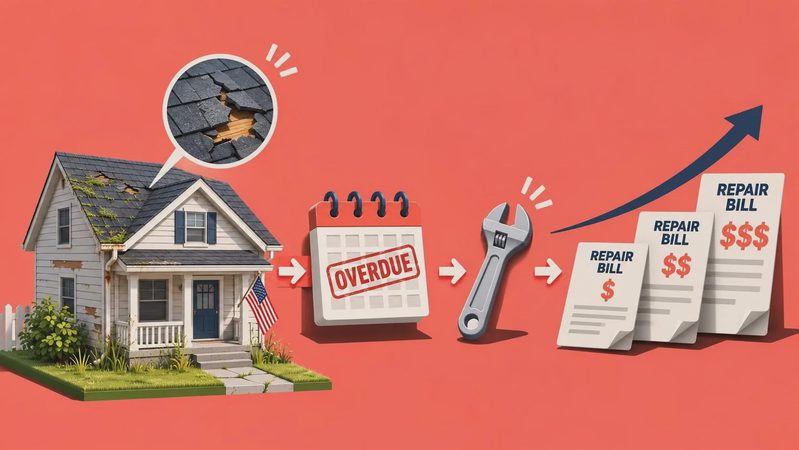
Roof leaks follow the same pattern. A missing shingle or failed flashing detail might cost $250 to $900 to address when first noticed. Leave it through a wet season and insulation, drywall, paint, and framing can push the repair into the $3,000 to $12,000 range. A clogged gutter may cost $150 to $300 to clean, while repeated overflow can contribute to fascia rot, basement seepage, or landscape drainage problems costing several thousand dollars.
This is why preventative maintenance cost should be compared with the cost of delay, not with zero. Zero is rarely the real alternative. Ignored maintenance becomes a repair, and repairs often happen on a weekend, during bad weather, or when you are least prepared to compare contractors.
Where to spend first in an older home
If your house is more than 20 years old, start with water and heat. Look for staining beneath bathrooms, around the water heater, under sinks, at the furnace condensate line, and near exterior doors. Stains that are dry and unchanged are not automatically emergencies, but active dampness, a musty smell, or soft material deserves prompt attention.
Next, evaluate the roof and drainage system from the ground. Binoculars are enough to spot curled shingles, sagging gutters, missing downspouts, and dark patches that do not match the surrounding roof. You do not need to climb up there to make a decision. A roof inspection commonly costs $150 to $400, while a roof replacement can run $8,000 to $20,000 or more depending on size, materials, and local labor.
Mechanical systems deserve a calendar rather than memory. A furnace tune-up may cost $100 to $250; replacing a failed heat exchanger or an entire furnace can cost several thousand dollars. Air-conditioning service often costs less than a major repair, but it will not rescue equipment that is already near the end of its useful life. The right preventative maintenance cost is the amount that improves reliability without pretending old equipment is new.

Seasonal priorities that actually matter
In spring, inspect gutters, downspouts, grading, window wells, and the lower corners of exterior walls. Watch where rainwater goes during a storm. If it collects against the foundation or pours beside the house, that observation is more valuable than buying another interior organizer. Gutter cleaning often costs $100 to $300, while correcting serious drainage can range from $500 for modest extensions to several thousand dollars for larger grading work.
Summer is a good time to watch the attic and cooling system. Excessive heat, damp insulation, or a bathroom fan that exhausts into the attic points to a ventilation or moisture issue. In fall, schedule heating service, inspect exposed plumbing, and clear leaves before they settle into drains. In winter, pay attention to pipes in garages, crawlspaces, and exterior walls. A frozen pipe can create a small leak or a full-floor water loss depending on where it breaks.
I compare seasonal maintenance to smoking meat: low, steady attention beats trying to rescue the brisket at the end. You do not need to inspect every inch of the home every weekend. You do need to look at the places where water, heat, and pressure concentrate.
How to build a household maintenance reserve
Start with the home’s replacement risks. If the roof is 18 years old and a replacement estimate is $12,000, setting aside $100 per month creates a useful reserve without pretending the roof will fail on a specific date. Do the same for the furnace, water heater, exterior paint, and major appliances. The preventative maintenance cost is easier to accept when it is tied to an expected life cycle and a dollar amount.
Keep a simple record with the date, observation, contractor note, and next decision. A photo of a foundation crack from March lets you compare it in September. A photo of a water heater connection shows whether corrosion is spreading. You are not building a construction textbook; you are creating evidence that helps you decide whether to monitor, schedule, or act now.
Insurance is not a maintenance plan. Homeowners coverage often addresses sudden, accidental damage, but wear, deterioration, neglected leaks, and poor upkeep may be excluded or limited. Preventative spending can protect your home even when a future claim would not be covered. That is a reason to maintain, not a reason to assume every repair will be reimbursed.
A practical decision threshold
Call a qualified professional this week when you find active water, a burning electrical smell, a warm or discolored outlet, a gas odor, rapidly spreading staining, or a structural crack that is widening. For less urgent findings, schedule an evaluation when the material is soft, the symptom returns, or the same repair has been postponed twice.
You can usually monitor a small, dry cosmetic crack that is narrower than a credit card and unchanged over several months. You can also wait for a convenient gutter appointment when the system is not overflowing and the fascia is sound. The point is not to turn every odd sound into a $1,000 service call. It is to separate harmless aging from a condition that is actively feeding a larger loss.
For most homeowners, the best preventative maintenance cost is a planned monthly reserve plus two focused inspection sessions each year. Spend first on water paths, roof drainage, heating and cooling, and safety concerns. Skip cosmetic upgrades until those are understood. A ten-minute check today saves a ten-thousand-dollar call tomorrow. Now go walk your basement; you have ten minutes.

No comments yet.