You are standing beside the furnace in October, listening to it start and stop. Nothing sounds terrible, so you close the door and move on. Then January arrives, the furnace quits during a cold snap, and the emergency service call begins. Understanding HVAC maintenance cost helps you decide which routine visits are worth paying for before a small issue becomes a major repair.
I used to write checks for this as a claims adjuster. Now I write about it so you do not need the check. The usual price for a professional heating and cooling tune-up is about $75 to $250 per system, depending on location, equipment, and what the visit includes. A maintenance agreement can run roughly $150 to $500 per year, sometimes covering two seasonal visits and discounted repairs.
What HVAC maintenance cost usually includes
A basic service appointment should be more than someone glancing at the thermostat and collecting a fee. For a furnace, the technician typically checks airflow, electrical connections, burners, the heat exchanger area, safety controls, drainage, and filter condition. For central air conditioning, the visit may include refrigerant-line inspection, electrical testing, condensate drainage, blower operation, and outdoor coil evaluation.
The technician should explain findings in plain language. “Your capacitor is weak” is useful only if you also learn whether it needs replacement now or can be monitored. A capacitor replacement often costs around $150 to $400, while a clogged condensate drain may cost $100 to $300 to clear. Those are very different decisions from replacing a compressor, which can run $1,500 to $3,000 or more.
HVAC maintenance cost also changes with access. A furnace in a clean basement mechanical room is faster to inspect than equipment in a cramped attic. A package unit on a roof, an older oil furnace, or a mini-split system may require specialized experience and different pricing. Ask what equipment is covered before approving a flat-rate plan.
When routine HVAC service is worth the money
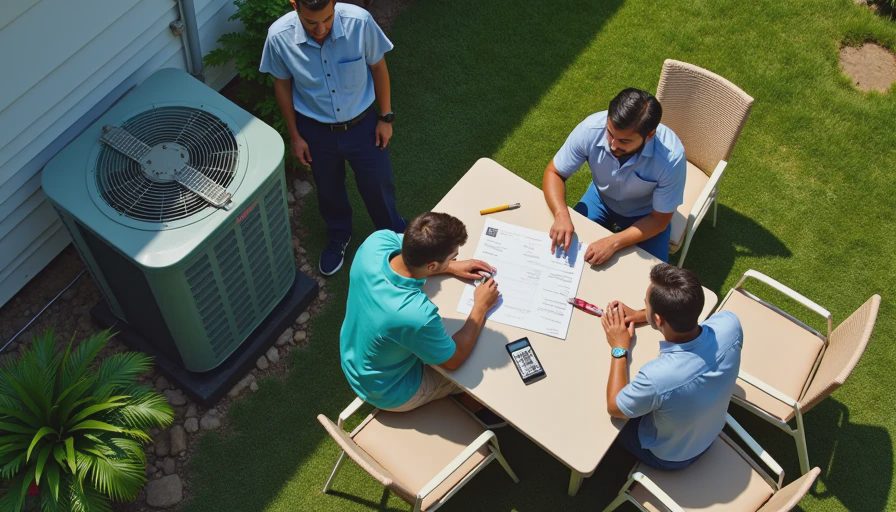
The strongest case for maintenance is an older system that you still need to depend on. If your furnace is 12 years old, your central air conditioner is 10 years old, or the system has already had one expensive repair, a seasonal inspection can reveal failing parts before they shut the system down. It will not make an aging unit new, but it can help you plan instead of panic.
Here is the decision threshold I use: pay for service when the visit can identify a safety concern, a developing failure, or a performance problem that affects the whole house. Uneven temperatures, a burning smell that does not quickly disappear, repeated short cycling, water around the indoor unit, or unusual grinding deserves attention. A filter that is dirty enough to restrict airflow is also worth correcting, because stressed equipment works harder and may wear sooner.
I once reviewed a claim involving a furnace that stopped during a cold week. The furnace itself was not the only problem. A neglected condensate line had leaked slowly into the surrounding platform, damaging flooring and part of a finished ceiling below. The HVAC repair was about $380. The water-related restoration was several thousand dollars. The lesson was not that every drain creates a disaster. It was that visible moisture around mechanical equipment should not be filed under “normal.”
How to judge a maintenance plan
A maintenance plan can make sense for a busy homeowner, especially when it includes spring air-conditioning service and fall heating service. Compare the plan with paying for two individual visits. A $200 annual plan that includes priority scheduling and a modest repair discount may be reasonable if your system is older or difficult to access. A $600 plan that mainly offers vague “preferred customer” language deserves more questions.
Ask whether labor for approved repairs is included, whether parts cost extra, whether emergency fees are reduced, and whether the agreement covers every system or only one unit. Some companies sell plans that include a basic inspection but charge separately for cleaning, refrigerant work, or electrical components. That is not automatically wrong; it simply needs to be clear.
The best HVAC maintenance cost comparison is not the cheapest quote. It is the price of the visit compared with the likely consequence of missing a known problem. Paying $125 to discover a weak blower motor is different from paying $125 for a rushed appointment that produces no readings, no explanation, and no written notes.

Costs homeowners often confuse with maintenance
Routine maintenance is not the same as repair, replacement, or energy-efficiency upgrades. Cleaning a coil may be maintenance. Replacing a failed condenser fan motor is a repair. Installing a new heat pump is replacement. Adding zoning controls or a smart thermostat is an improvement, not a required service item.
Typical repair prices vary widely. A thermostat replacement may cost $100 to $350. A blower motor can land around $400 to $1,000. A furnace igniter or flame sensor is often less expensive, while a cracked heat exchanger can change the conversation completely because safety, equipment age, and replacement economics matter. Do not authorize a major replacement solely because a technician says the system is “old.” Ask for the failure, the repair price, the expected remaining life, and the replacement estimate.
If your unit is working normally and a salesperson recommends several upgrades during a basic tune-up, slow down. Get the findings in writing. You can spend $5,000 trying to prevent a $200 nuisance, and I have seen homeowners do exactly that.
A practical seasonal schedule
In spring, schedule cooling equipment before the first sustained heat wave. Look for poor airflow, water near the indoor coil, and an outdoor unit packed with debris. In early fall, have the heating system evaluated before nighttime temperatures drop. Replace filters according to the equipment and household conditions, not an automatic sales pitch for a costly product.
Walk past the mechanical room once a month. Notice new stains, rust, dampness, disconnected insulation, unusual sounds, or a system that runs much longer than it did last season. You are not repairing anything; you are establishing a baseline. A ten-minute check today saves a ten-thousand-dollar call tomorrow.
For a newer system under warranty, follow the manufacturer’s maintenance requirements and keep receipts. For an older system, put the maintenance money beside a replacement fund. An annual service visit costing $100 to $200 can be sensible, but it should be part of a larger plan rather than a promise that failure is impossible.
The bottom line on HVAC maintenance cost
For most single-family homeowners, a reasonable HVAC maintenance cost is $75 to $250 for one professional visit and approximately $150 to $500 for a useful annual plan. The price is justified when the inspection is detailed, the findings are documented, and the equipment has meaningful age or warning signs. It is less compelling when the system is new, covered by a clear warranty, and operating without symptoms.
Before booking, ask what will be inspected, what is included in the quoted price, and whether repairs require separate approval. Then check the equipment yourself today for moisture, odd sounds, restricted airflow, or a filter that is overdue. Now go walk your mechanical room. You have ten minutes.

No comments yet.